Towards your HTB Certified Detection Engineering Principal
Detection Engineering

HTB Certified Detection Engineering Principal (HTB CDEP)
HTB Certified Detection Engineering Principal (HTB CDEP) is an advanced, practical, scenario-based certification designed to validate learners’ ability to apply detection engineering concepts in real-world enterprise environments. The candidates will work across areas including Windows and Linux telemetry, process and memory activity, API and callstack analysis, low-level detection opportunities, analyzing suspicious binaries and debugging the execution flows, identifying relevant attack techniques, and developing robust detection logic.
Target Audience
- Detection Engineers
- Security Researchers
- SOC Analysts
- Malware Analysts
- Security Analysts (focusing on Threat Monitoring and Detection Engineering)
- DFIR Practitioners
- Threat Hunters
- Red Team Operators (who want to understand how detections are created)
HTB CDEP – Key Differentiators
Find below the facts that differentiate HTB Certified Detection Engineering Principal (HTB CDEP) from standard certifications:
Continuous Evaluation - Candidates must complete the entire "Detection Engineer" job-role path before starting the exam. All of the modules end with a hands-on skills assessment that students must pass. Evaluation happens throughout the path, not just during the final exam.
Hands-on & Real-world Exam Environment - Candidates perform Detection Engineering assessments against realistic enterprise environments that include a realistic attack chain. The exam requires executing actual attacks against these systems — no multiple-choice questions.
Outside-the-box Thinking - Candidates must combine skills and techniques from across the path to achieve the exam's objectives. As in real engagements, creativity and deep technical knowledge are required to succeed.
Adversary-tradecraft focused - Tests the ability to understand how attacks are actually executed and the different attack phases an attacker goes through.
MITRE ATT&CK Aligned - Assessment scenarios are mapped to relevant adversary techniques and behaviors.
Think like both an Adversary and a Defender - Apply knowledge of adversary tradecraft to identify meaningful behavioral signals that can be detected reliably.
Commercial-grade Report Requirement - Completing the exam is not enough to pass. Candidates must also document their process for investigating adversary behavior and identifying the different TTPs across all attack phases. Candidates are also expected to provide the relevant detection opportunities for these TTPs. The report must meet professional, client-ready standards and must clearly communicate findings, supporting evidence, attack progression, detection logic, and limitations.
Knowledge domains
The HTB Certified Detection Engineering Principal (HTB CDEP) certification evaluates the candidates’ knowledge of the following:
- Detection Engineering Fundamentals — Detection lifecycle, analytics development, testing, validation, tuning, and operationalization.
- MITRE Frameworks — MITRE ATT&CK, D3FEND, technique mapping, and adversary behavior analysis.
- Security Telemetry and Data Sources — Understanding endpoint, process, network, ETW, ETWTi, Sysmon, and kernel telemetry.
- Windows Internals — Processes, memory, execution flow, APIs, tokens, services, and Windows security architecture.
- Linux Security Concepts — Linux processes, memory, system calls, /proc, permissions, and security telemetry.
- Process and Memory Analysis — Process behavior, memory regions, injection techniques, allocations, and execution artifacts.
- User and Kernel-Level API Monitoring and Hooking — API instrumentation, function hooking, parameters, callstacks, and low-level behavioral signals.
- Malware Behavior Analysis — Static and dynamic analysis of malicious behavior, execution chains, and adversary tradecraft.
- Threat Hunting Methodologies — Hypothesis-driven hunting, telemetry-driven investigation, behavioral analytics, and threat discovery.
- Endpoint Detection and Response (EDR) Concepts — EDR telemetry, behavioral detection, endpoint visibility, correlation, and detection limitations.
- Debuggers, Disassemblers, and Advanced Analysis Tools — Practical use of tools such as WinDbg, Ghidra, x64dbg, and related analysis techniques.
- Developing behavioral detection logic based on attacker techniques.
- Understand the telemetry resources, their data format, and their ability to work with them in order to identify and detect malicious activity
- Ability to understand and investigate low-level concepts, publicly documented or not, and the application of these to Detection Engineering
The Exam
The HTB Certified Detection Engineering Principal (HTB CDEP) exam is a hands-on, scenario-driven assessment designed to evaluate how candidates approach real-world detection engineering challenges. Candidates will investigate simulated security incidents, analyze different telemetry sources and suspicious artifacts, identify adversary techniques, and develop evidence-based conclusions.
The exam goes beyond simply identifying an attack. Candidates will be expected to trace adversary behavior across all ATT&CK phases, identify relevant telemetry, correlate multiple data sources, develop or validate detection logic, and assess whether the available telemetry provides sufficient visibility.
A key component of the assessment is the Commercial-Grade Report Requirement, where candidates must document their investigation and findings aligned with MITRE ATT&CK in a professional format suitable for communicating with a security operations, threat hunting, or detection engineering team.
The exam ultimately evaluates whether a candidate can take an observed adversary behavior and turn it into a practical, explainable, and defensible detection capability.
HTB CDEP is for individuals who want deep technical competency in low-level detections. While it's not a strict requirement, it's strongly advised to have completed the HTB Certified Defensive Security Analyst (HTB CDSA) certification or at least to have acquired all the knowledge the “Detection Engineer” job-role path encompasses. Several modules within this path expect knowledge covered by CDSA, and required modules are also mentioned in the individual modules as well.
The following is a list of prerequisites for a successful outcome:
- Interpreting a letter of engagement
- MITRE ATT&CK techniques, tactics, and adversary behaviors
- Windows and Linux fundamentals, including processes, memory, APIs, and system internals
- Security telemetry and logging, including Sysmon, ETW, Windows Event Logs, and process telemetry
- SIEM platforms and basic query development, particularly Splunk or equivalent technologies
- Malware analysis fundamentals, including basic static and dynamic analysis
- Detection development, including writing, testing, validating, and tuning detection logic
- Basic scripting/programming and command-line skills
- Familiarity with Windows debugging, callstacks, API monitoring, and process injection concepts
A candidate will not require their own computer in order to complete this exam, pwnbox has adequate resources to complete all tasks.
1. Complete the Detection Engineer job-role path 100%
Candidates must complete the "Detection Engineer" job-role path 100% before becoming eligible for the exam. The path contains a mix of theory and interactive exercises that prepare you for the HTB CDEP exam.
2. Get an exam voucher
An exam voucher* is required to start the exam. HTB Academy's Gold Annual subscription includes a free exam voucher. Otherwise, vouchers can be purchased separately from the Academy billing page. You must complete the "Detection Engineer" path before redeeming a voucher.
Each voucher includes two (2) exam attempts.
Vouchers expire 1 year from the date of purchase.
*Each Academy for Business seat comes with an exam voucher
3. Enter the exam
After completing the "Detection Engineer" path and obtaining an exam voucher, start the exam by clicking "Exams" (left side of Academy's main page), then "EXAM INFORMATION," then "ENTER EXAM."
Lab and report submission deadlines are visible on the exam lab page. Reminder emails are sent so you can track deadlines and voucher expiration.
4. Start Investigation
After clicking "ENTER EXAM" and accepting the terms and conditions, you receive a letter of engagement with all engagement details, requirements, objectives, and scope. A report template is also provided.
You can then begin your assessment against the environment described in the letter of engagement. A good strategy is to keep detailed notes and start drafting your report as you go.
You will also submit flags on the exam lab page to confirm you achieved each objective.
The exam lab will be accessible for ten (10) days without restrictions.
Each candidate gets a dedicated exam lab instance. You can work uninterrupted by other candidates and reset the lab at any time.
Passing requires earning enough points and submitting a commercial-grade report.
5. Upload your report
Based on the provided template report, you must professionally document the identified TTPs, the detection process, and detection opportunities.
You will have ten (10) days to upload your report on the exam lab page from the time you enter the exam (step 3).
Please note that if you don't upload a report within the deadline, your exam voucher will expire and you won't be provided with a second exam attempt!
6. Obtain your results
An HTB Academy instructor checks your point total and evaluates your report. If it meets the quality requirements, you receive the HTB CDEP certification. Results are returned within 20 business days (usually sooner).
If you fail the first attempt, an HTB Academy instructor will identify areas where you are lacking and provide constructive feedback for improvement. The instructor's feedback will be available on the exam page, "EXAM HISTORY" tab.
You get one free retake. Use the instructor's feedback, perform your assessment again, and upload a new report within ten (10) days of starting the retake.
You have fourteen (14) days after receiving first-attempt feedback to start your retake. If you don't, the voucher expires.
Once you successfully pass the exam, you can claim the digital certificate and download it from the "EXAM HISTORY" tab.
HTB Academy certifications have no expiration date!
How to get certified:
- Enroll in the Detection Engineer job-role path and complete all included modules 100%
The Detection Engineer path covers the vast majority of the attack techniques included in the exam, as well as the different detection methodologies and the skills needed to prepare for the HTB CDEP certification.
- Get an exam voucher
An exam voucher* is required to start the exam. HTB Academy's Gold Annual subscription includes a free voucher. Otherwise, purchase one separately from the Academy billing page. Complete the Detection Engineer path before redeeming.
Vouchers expire 1 year from purchase.
- Each Academy for Business seat comes with an exam voucher
Submit a certificate ID at the link below to verify its validity.
https://www.hackthebox.com/certificates
Get Certified as HTB Certified Detection Engineering Principal
Detection Engineer Job-Role Path
Detection & OpSec Cyber Range
HTB Academy’s Detection & OpSec Cyber Range is an advanced extension of the purple modules, designed to support both detection engineering and operational security assessment following user-driven attack simulations. It features isolated, fully interactive networks with Windows and Linux purple module targets, generating real-time logs and telemetry, all centrally monitored via Splunk and Wazuh. Built for both blue and red team professionals, the range's reusable infrastructure and pre-installed tooling provide a safe and dedicated environment for identifying post-attack artifacts, developing and validating detections, and evaluating tradecraft exposure, without the need to set up or manage complex, technically demanding infrastructure.

Introduction to Detection Engineering
This HTB Academy module introduces the foundational and advanced concepts required to think and operate like a modern detection engineer. The module explains how attackers operate within Windows environments, how operating system telemetry exposes those behaviors, and how defenders can convert raw telemetry into actionable detections. It contains various hands-on tasks to simulate an attack technique and design detection queries to detect it.
Introduction to Dynamic Analysis with WinDbg
This module covers the fundamentals of using the debugger and examines various practical cases where dynamic analysis helps uncover malware TTPs on Windows. It extends to both user-mode and kernel-level debugging, demonstrating how to detect behaviors associated with rootkits or exploits, and how the internal structures of the kernel can reveal the presence of malware.

Process Injection Attacks and Detection
This module focuses on understanding the process injection techniques attackers use to execute malicious code within the context of legitimate processes. This detection engineering module covers various injection methods, such as DLL injection, reflective DLL injection, QueueUserAPC, section mapping injection, TLS callbacks, and process hollowing, covering the implementation and detection opportunities of each approach.

Linux Process Injections & Detections
This module introduces various Linux process injection techniques, from basic to advanced ones, from both local and remote standpoints. It focuses on how ELF sections and dynamic-linking structures can be abused for execution flow hijacking and evasion while overriding potential memory protections. It also explores the various detection opportunities and dynamic analysis techniques that can be employed for prevention and mitigation tasks.

Windows Low Level Detectability
This module introduces user-mode threat detection on Windows, focusing on low-level techniques and dynamic analysis. It covers the Win32 API, Windows Internals, PE file structures, DLL injection, system call interception, control-flow and kernel return instrumentation, stack trace analysis, and more. It sets a foundation for detecting suspicious memory activity, user-mode evasion methods, and control-flow obfuscation techniques from a programmatic approach.

Detecting Access Token Manipulation Attacks
This module focuses on Windows privilege escalation techniques through access token manipulation. It covers various topics, including Windows processes, access tokens, token privileges, and token manipulation. By using tools such as API Monitor, Process Monitor, Sysmon, WinDbg, and disassemblers for analysis, we will investigate the relevant event logs and telemetry generated through Event Tracing for Windows (ETW).

Windows API Monitoring and Hooking
This module introduces the monitoring and hooking techniques for Windows APIs. These techniques are used in debugging, reverse engineering, malware analysis, and so on. It covers the Win32 API, Windows Internals, interception, and more. It focuses on how to intercept and monitor API calls made by Windows applications in real-time, helps to understand how a program interacts with the operating system, manipulate or analyze its behavior, and develop tools for analysis.

Privilege Escalation Tradecraft Analysis
This module covers the analytical study of privilege escalation tradecraft on Windows, from its role in the attack lifecycle to how it can be detected and investigated. It focuses on how attackers abuse core Windows mechanisms to escalate privileges and bypass access control. Throughout the module, you will analyze real-world techniques and exploits to understand how they work internally and learn how to translate this knowledge into effective and reliable detection strategies.

Persistence Tradecraft Analysis
This module covers the persistence tradecraft on Windows, from its role in the attack lifecycle to its detection and investigation. Persistence mechanisms allow adversaries to maintain access to compromised systems even after reboots, logoffs, or system interruptions. In Windows environments, attackers often abuse legitimate system features such as Scheduled Tasks, Services, and Registry-based startup mechanisms to ensure their malicious code executes automatically. Understanding how these techniques operate and how they appear in system artifacts is essential for detecting and investigating long-term intrusions. Throughout the module, you will explore real-world persistence mechanisms to understand how they work internally and learn to translate this knowledge into effective, reliable detection rules.

WMI Tradecraft Analysis
This module introduces WMI (Windows Management Instrumentation) based attack and analysis techniques, from both local and remote standpoints. WMI is a core Windows management technology that is frequently abused by attackers for stealthy execution, lateral movement, and persistence. It provides a structured analysis of WMI tradecraft and focuses on how adversaries weaponize WMI and how defenders can detect, hunt, and investigate malicious WMI activity in enterprise environments.

Credential Access Tradecraft Analysis
This module delivers an in-depth, defense-focused study of Windows credential access. It explains how adversaries steal credentials via dumping and abuse of sensitive stores, then breaks down authentication flows, cryptographic protections, and both live-memory and offline extraction to understand tool behavior and build robust detection rules. It also covers DPAPI, Windows Credential Manager, browser credential stores including App-Bound encryption, and Credential Guard bypass techniques with their detection opportunities.

Windows Kernel Telemetry & Detection Techniques
This module offers a deep dive into Windows kernel telemetry mechanisms from a defensive security perspective, covering a broad spectrum of telemetry sources exposed by the operating system kernel. It focuses on Event Tracing for Windows (ETW), kernel-mode drivers, and filtering drivers, exploring their roles in monitoring and analyzing system activity. The module includes the design and implementation of detection logic for various TTPs, using a combination of telemetry sources along with documented and undocumented kernel structures, data, and technologies. The module also dives comprehensively into the kernel-level internals of the various concepts that it presents and analyzes real-world use cases to illustrate their practical application in threat detection.
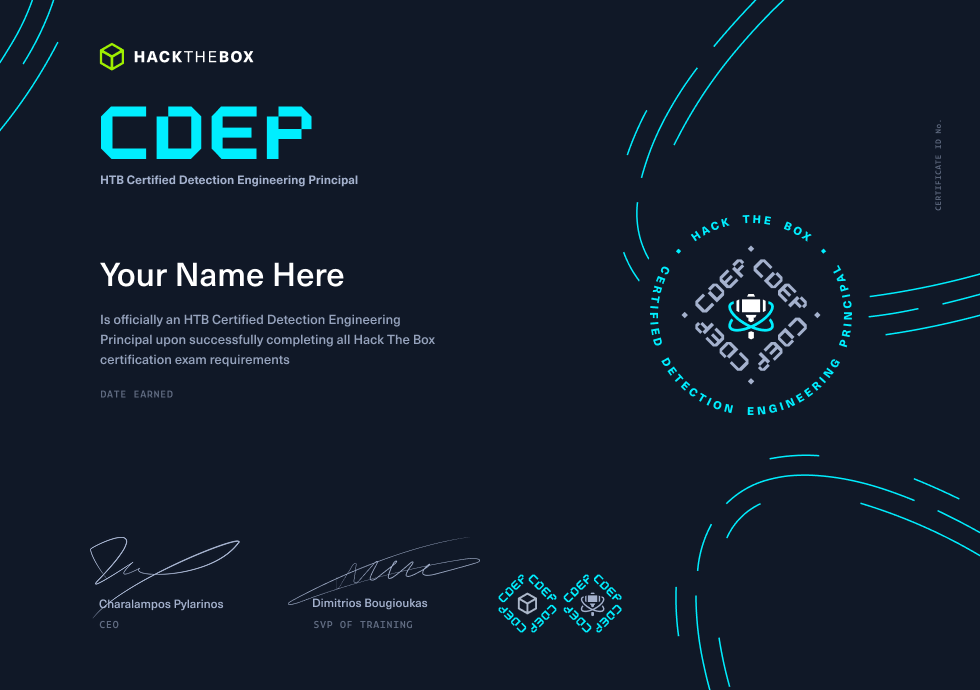
HTB Certified Detection Engineering Principal Certificate
HTB Certified Detection Engineering Principal (HTB CDEP) is an advanced, practical, scenario-based assessment designed to validate learners’ ability to apply detection engineering concepts in real-world enterprise environments. The candidates will work across areas including Windows and Linux telemetry, process and memory activity, API and callstack analysis, low-level detection opportunities, analyzing suspicious binaries and debugging the execution flows, identifying relevant attack techniques, and developing robust detection logic.
Key Takeaways:
- Detection Engineering Process
- Detection Logic Creation
- Detection Validation
- Adversary Simulation
- Dynamic Analysis with WinDbg (Dynamic analysis, debugging, execution tracing, behavioral analysis)
- Process Injection Attacks & Detection (Windows & Linux)
- Windows Low-Level Detectability
- Access Token Manipulation Detection
- Windows API Monitoring and Hooking
- Privilege Escalation Tradecraft Analysis
- Persistence Tradecraft Analysis
- WMI Tradecraft Analysis
- Credential Access Tradecraft Analysis
- Windows Kernel Telemetry & Detection Techniques