 Mini-Module
Summary
The Threat Hunting with Email Security module is designed for
- Threat hunters focusing on email security systems and
- Security analysts and professionals involved in incident response. Throughout this module, students will develop
- Master the use of email security systems for effective threat hunting, - Develop skills to analyze and respond to email-based security incidents, and
- Enhance abilities to integrate email security tools within a broader cybersecurity framework.
Recommended prior knowledge:
-
Basic knowledge of cybersecurity principles
-
Familiarity with email communication systems
-
Experience with security monitoring tools
Introduction
In today's digital world, email has emerged as one of the cornerstones of both personal and business communications. However, this widespread use makes email accounts an attractive target for cyber attackers. Cybercriminals can cause significant damage by targeting users and organizations using methods such as phishing, spreading malware, and Business Email Compromise (BEC). This is where email-based threat hunting enters the picture.
Email-based threat hunting is the process of in-depth analysis of email traffic to identify, analyze, and prevent potential threats and attacks. Detecting suspicious activity and malicious content requires advanced analysis techniques, threat intelligence, and automation tools. The goal is to catch and neutralize threats as quickly as possible before they start to spread.

Common E-Mail Threats
-
Spam:It is classified as unsolicited email sent in bulk. In some cases, spam emails may contain links that download malicious files. -
Phishing:It is a type of attack in which cybercriminals use deceptive emails, advertisements, links, or messages to steal personal information or gain access to online accounts. According to Verizon, phishing accounts for 36% of breaches. -
Malware:It is an attack method in which cybercriminals use malicious code in email messages to infect one or more devices. By 2020, email malware attacks will increase by 600%. -
Spoofing:It is a technique used by cybercriminals in spam and phishing attacks. It tricks users into believing the message is from someone they know or trust, such as a familiar person or organization. -
Botnet Messages:It is a method of infecting a computer network with malware. The network is controlled by a single attacker known as the "botnet leader. Botnet messages are used to launch attacks, steal data, send spam, and gain access to devices. -
Business Email Compromise (BEC):In this method, attackers gain access to a business email account and impersonate its owner. These attackers often target companies that conduct wire transfers and have overseas suppliers.
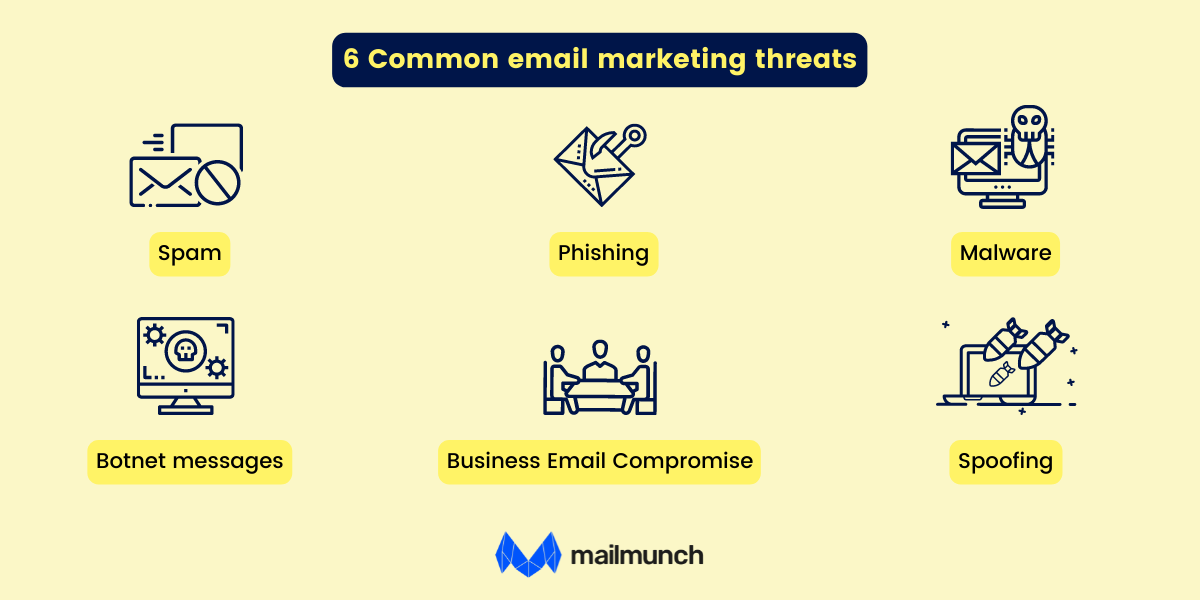
( Image Source : https://www.mailmunch.com/blog/email-security-best-practices )
This section of the module provides an introduction to the topic. The next section will cover the Role of Email Security Systems in Threat Hunting .”