 Mini-Module

Summary
The SIEM Alert Generation module is designed for cybersecurity professionals specializing in threat detection and response and System administrators interested in configuring alerts for security. Throughout this module, students will develop mastery in creating and configuring alerts within SIEM systems, skills to design targeted alerts for proactive threat detection, and enhanced capabilities in responding to potential security threats.
Recommended prior knowledge:
-
Basic knowledge of SIEM systems and their functionalities
-
Understanding of cybersecurity principles and threat detection
SIEM and Rule/Correlation
Fighting against today's sophisticated cyber threats requires organizations to continually strengthen their security measures. Therefore, security teams are looking for an effective approach to monitor their networks and systems, detect and respond to potential threats. This is where SIEM systems and the rule/correlation relationship come into play. The real power of SIEM comes from the rules and correlation capabilities used when analyzing this data.
The basic rules that the SIEM system uses to detect certain events or situations are called rules. For example, a rule might be triggered if a particular user has multiple failed login attempts, or if there is an unexpected increase in traffic on a particular port. However, complex and advanced threats often occur not in a single event, but as a result of multiple events simultaneously occurring. Here's where correlation plays a role.
Correlation enables the detection of a potential threat by cross-analysis of different events and data points. Specifically, it is used to describe a possible threat that may arise from a series of events occurring together. For example, a combination of events, such as a user making many unsuccessful login attempts, or trying to pull sensitive data from another device, can trigger a correlation rule. This goes beyond isolated incidents and helps detect more complex threats.
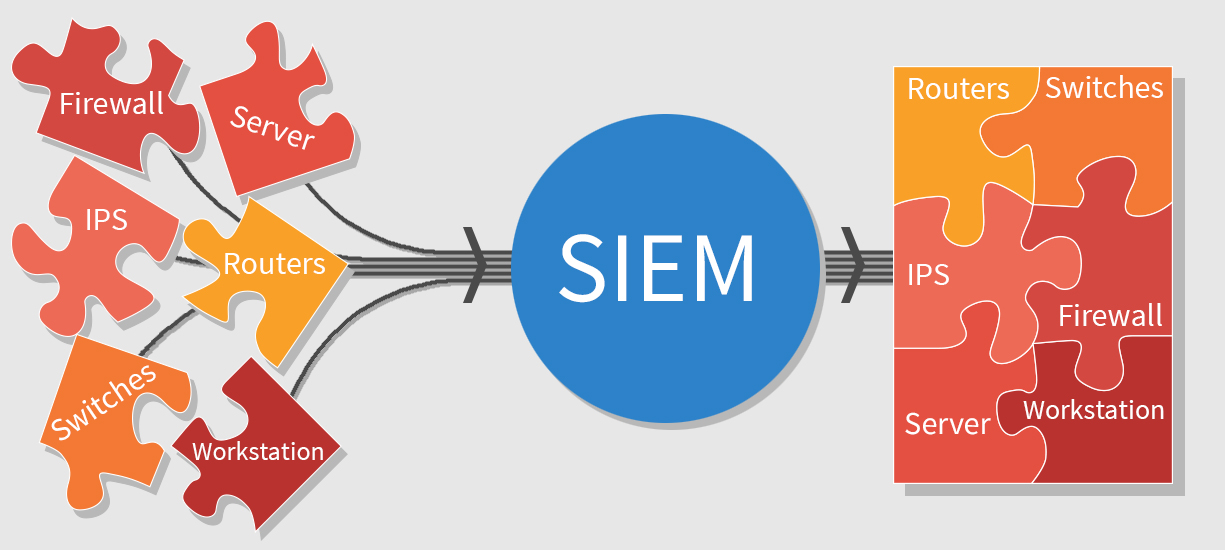
(Image Source: https://www.pratum.com/blog/122-benefits-of-log-consolidation-in-a-siem-environment )
SIEM and the rule/correlation relationship enhance organizations' ability to defend against cyber threats by enabling them to detect and respond to security incidents more quickly and effectively.
Rules-Based Threat Detection
Rule-based threat detection is a security approach that involves defining specific rules and patterns within a security system and identifying events or activities that conform to these rules.
Rule-based threat detection relies on a specific set of rules when monitoring events and activities occurring within an organization's security infrastructure. These rules are used to assess compliance with the organization's security policies, recognize potential threats, and detect specific security events or patterns.
Rules used for rule-based threat detection represent a combination of one or more conditions. Each rule contains a condition or pattern that describes a particular event or activity. An example rule might be: "If a user enters an incorrect password three times consecutively, generate a security alert."
Rules-based threat detection begins with applying rules to events or activities collected from data sources. If an event or activity contains a condition that complies with one or more rules, that rule is triggered. Triggering the rule may lead to the generation of a security alert or the execution of a specific action.
Rule-based threat detection is used in many security areas such as network, application, data, and system security. For example, network traffic monitoring and rule-based threat detection are commonly used to detect malicious network traffic and unwanted activities.
Rule-based threat detection provides effective defense against specific and known threats. However, this method also has disadvantages including potential limitations in detecting unknown or advanced threats and the possibility of generating false positive alarms.
For up-to-date and effective rule-based threat detection, rules need to be reviewed and updated regularly. Current rules must adapt to both the security needs of the organization and the evolving threat landscape.
Rule-based threat detection is a powerful tool for monitoring security incidents in organizations and automatically detecting events that comply with certain rules. However, because of its limitations, organizations often combine rule-based detection with other advanced security approaches and threat intelligence.
Correlation-Based Threat Detection
Correlation-based threat detection monitors an organization's network security and detects threats by analyzing security events and data. This approach goes beyond isolated events and involves evaluating multiple events and data points together.
Correlation refers to the process of identifying meaningful relationships between events and data. In particular, it aims to detect a possible threat as a result of the combination of many separate events or activities. This approach typically includes data from different sources, such as network traffic, system logs, user behavior, and threat intelligence.
Scenarios that use correlation include detecting abnormal activities on the network, monitoring malware attacks, detecting data leaks, and detecting advanced threats. For instance, you can use correlation to identify multiple users attempting to access sensitive data simultaneously or to recognize a certain malware showing similar behavior on different systems.
Correlation-based threat detection is implemented using specialized correlation engines or security solutions such as SIEM systems. Correlation engines analyze data using specific rules and algorithms and try to identify potential threats. Correlation engines can be customized to lower false alarm rates and identify genuine risks.
Advantages and Disadvantages of Threat Detection with Correlation:
Advantages:
-
Ability to detect advanced threats.
-
Understanding relationships between data points.
-
High customization ability.
Disadvantages:
-
It can be complicated and time-consuming.
-
It May lead to False Positive results (risk of missing real threats).
Correlation-based threat detection helps organizations develop a more effective defense strategy against more complex and advanced cyber threats. This method allows organizations to be better prepared against potential threats by conducting a more thorough analysis of security incidents.
In this part of the training, we have discussed what correlation is, its significance, its relationship with SIEM, and rule/correlation-based threat detection. In the next part of the training, the subject Basic Components of the Correlation Rule will be explained.