 Mini-Module
Summary
The Information Security Basics module is designed for iT professionals seeking to specialize in Information Security, Cybersecurity enthusiasts aiming to build a solid foundation in the field, and Individuals responsible for managing or overseeing Information Security practices in organizations. Throughout this module, students will develop a comprehensive understanding of Information Security Basics, the ability to identify and analyze components crucial to Information Security, the ability to implement effective access control measures and risk management strategies, and guide documents for efficient Information Security management.
Recommended prior knowledge:
-
Basic knowledge of computer systems and networks
-
Familiarity with fundamental IT concepts
-
Understanding of general cybersecurity principles is advantageous but not mandatory
Introduction to Information Security Basics
Due to the increasing use of information technologies in both corporate operations and daily life, the importance of information security has gained significant importance. And so professionals have shown a growing interest in the field of information security, leading to a need for comprehensive training. Furthermore, the field of information security is quite extensive and encompasses various disciplines.
This module will provide a fundamental overview for professionals aiming to advance in any domain of information security, primarily focusing on cybersecurity. This will help prevent professionals from feeling a lack of basic information security knowledge as they progress in their areas of expertise.
A Simple Classification for Information Security Domains
It has been previously emphasized that cybersecurity is an extensive subject, and it can be challenging to delineate its boundaries. Therefore, a basic level classification to understand this extensive scope can be highly beneficial.
Furthermore, it will also help professionals considering a career path in information security to chart the right module.
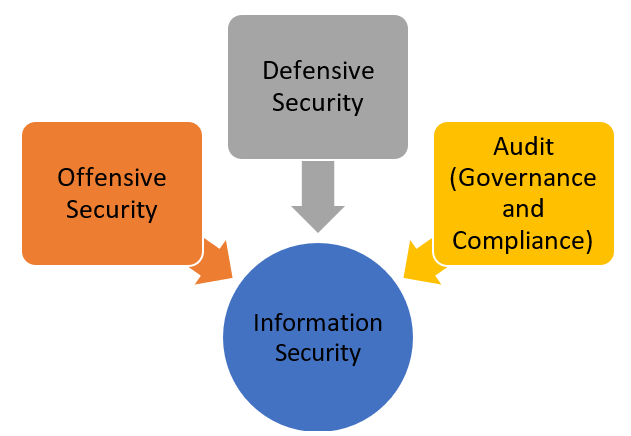
The main domain of information security can be divided into three categories based on the method and purpose of the work, as follows:
-
Offensive Security
-
Defensive Security
-
Audit (Governance and Compliance)
Offensive Security
Offensive security, often referred to as ethical hacking or penetration testing, involves actively testing an organization's computer systems, networks, and applications to identify vulnerabilities and weaknesses.
Defensive Security
Defensive security refers to the proactive measures and strategies employed by organizations to protect their digital assets and sensitive information from cyber threats and unauthorized access. It involves implementing security controls, monitoring for potential vulnerabilities, and establishing incident response plans to mitigate and respond to security incidents.
Audit
Audit activities focus on auditing information security practices, often carried out following specific regulations or standards. They can be assessed under the headings of IT governance and compliance.
Definition for Information Security
In this section, we will provide important concepts in the information security field and basic definitions for them.
Data
Facts, concepts, or instructions are represented in a formalized manner suitable for communication, interpretation, or processing.
Information
Data that is processed into a form that is meaningful and useful to its intended recipient and is an asset to an organization.
Data vs Information
Data stands for raw, unprocessed facts or figures, whereas information represents data that has been processed, organized, or structured in a meaningful way to convey knowledge or facilitate decision-making.
However, from a security perspective, this distinction should be emphasized, instead, information security is considered a broader umbrella term that encompasses data security as well.
Asset
An asset is anything related to information that should be protected. This may include computer files, network services, system resources, processes, programs, IT infrastructure, databases, hardware devices, product recipes/formulas, intellectual property, personnel, software, facilities, etc.
Components that are ineffective in ensuring information security are not considered an "asset" within the scope of information security. For example; The air conditioner that cools the systems in the data center is an "asset" while the air conditioner that provides the comfort of employees in the office is not.
Information Security
Information security, sometimes abbreviated as InfoSec, protects information by mitigating risks and is part of information risk management.
It typically involves preventing or reducing the probability of unauthorized or inappropriate access to data, as well as the unlawful use, disclosure, disruption, deletion, corruption, modification, inspection, recording, or devaluation of information.
Cyber Security vs Information Security
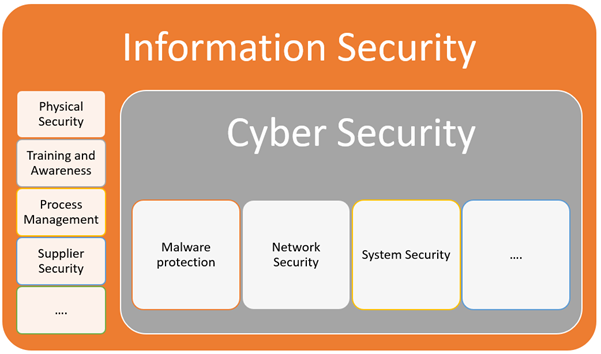
Typically, when we mention information security, the first thing that comes to mind is cybersecurity and related topics like network security, malware analysis, system management, and so on.
However, even though cybersecurity is quite popular, it should be considered as a subset within the broader domain of information security. This distinction arises because the information security domain encompasses various topics, including physical security and user security, which aren't specifically categorized under cybersecurity.
In this part of the module, information security basics are introduced. In the next part, Components of Information Security will be explained.