 Mini-Module

Summary
The Cryptographic Algorithms module is designed for computer science and information technology students, Software developers and engineers interested in cybersecurity, IT professionals seeking to enhance their knowledge of cryptographic systems, and Cybersecurity enthusiasts and practitioners. Throughout this module, students will develop an understanding of fundamental cryptographic principles and their real-world applications, the ability to analyze and compare various cryptographic algorithms and protocols, and design and implement secure cryptographic systems.
Recommended prior knowledge:
- Basic understanding of computer science principles
Definitions for Cryptographic Algorithms
Cryptographic Algorithm
A cryptographic algorithm is a set of mathematical rules and procedures used to transform plaintext data into ciphertext and vice versa, ensuring the information's confidentiality, integrity, and authenticity.
These algorithms are fundamental in the field of cryptography, providing the basis for secure communication and data protection in various applications, including online transactions, secure messaging, and data storage.
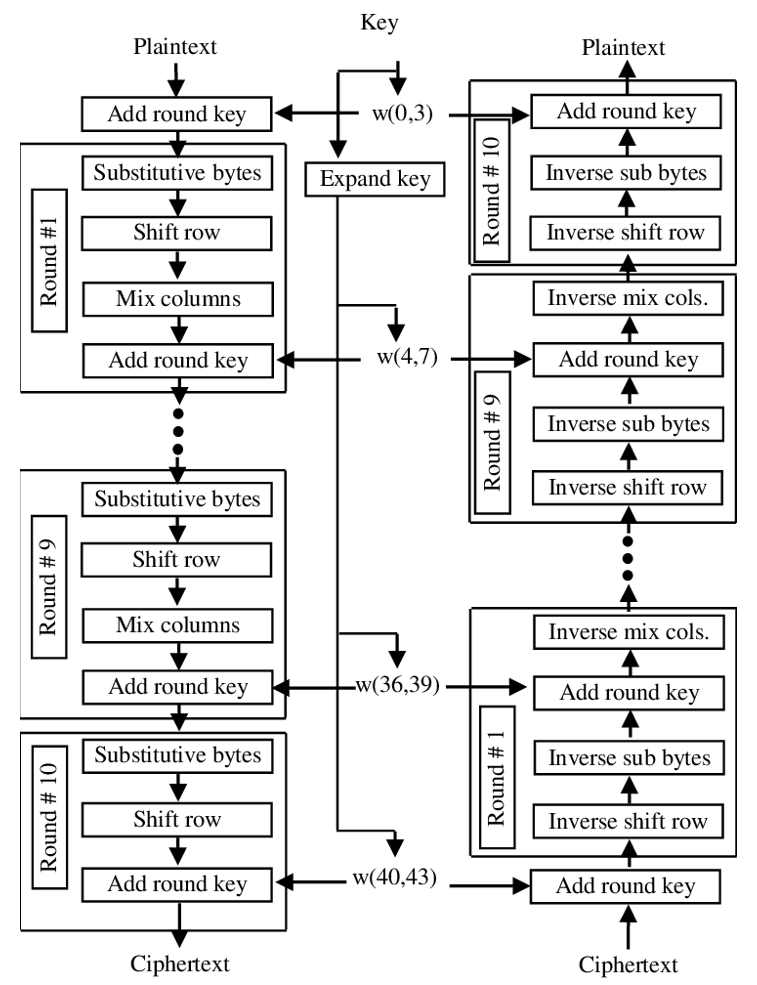
( Image Source : https://www.researchgate.net/ )
For example, implementing the AES algorithm would be a wise idea.
Cryptographic Protocol
A cryptographic protocol is a set of rules and procedures for securely exchanging information over a network or channel.
These protocols define how encryption, authentication, and other security mechanisms are applied to ensure the confidentiality and integrity of data during transmission, making them essential for secure online communication, such as HTTPS for web browsing and TLS/SSL for secure connections.
Although DNS, TCP, UDP, and ICMP protocols are not considered cryptographic protocols, they can be considered good examples of protocols for IT operations.
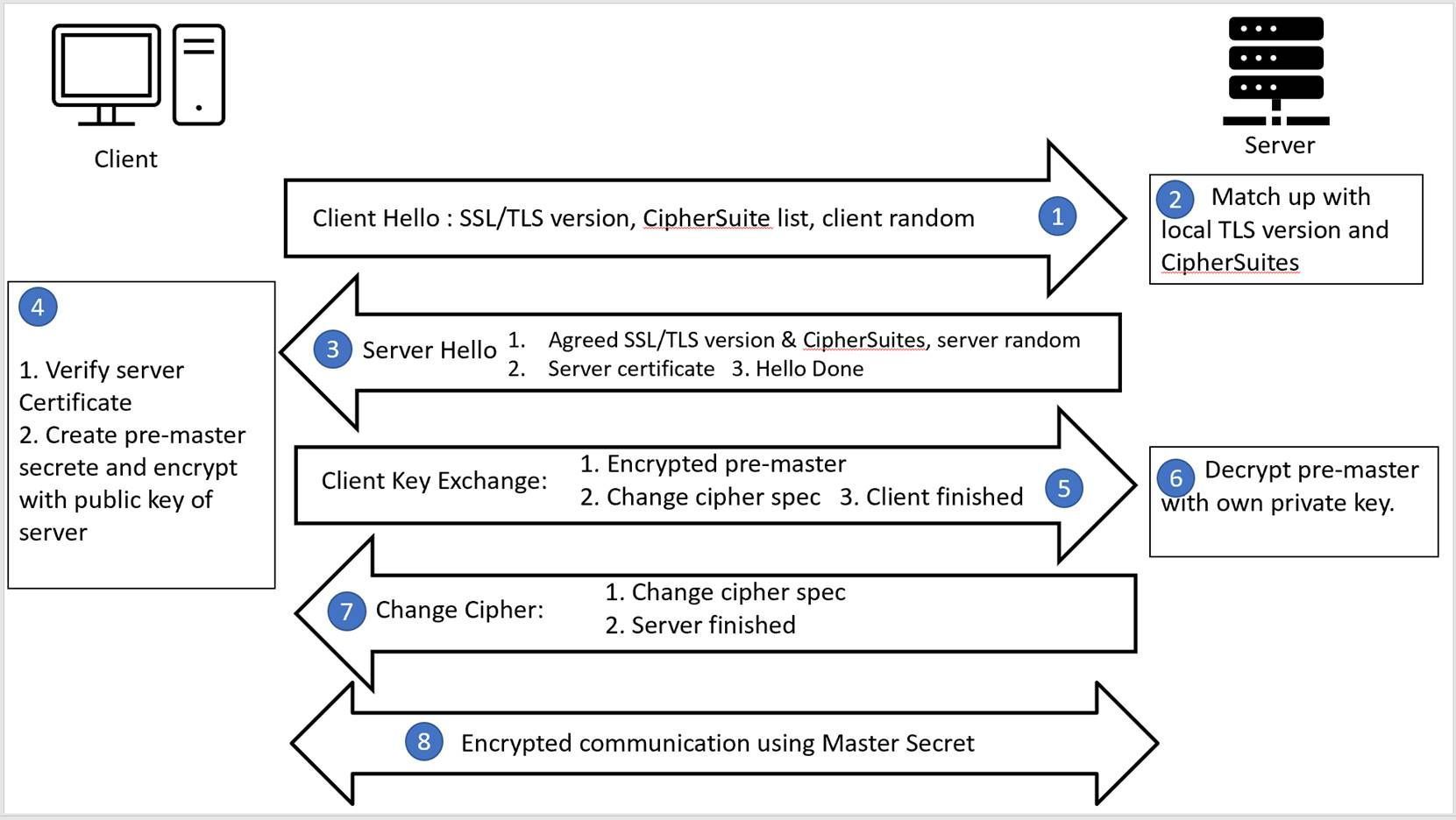
( Image Source : https://wentzwu.com/ )
Keyspace
Keyspace is the range of potential keys that can be used to encrypt and decrypt data and refers to the total number of possible encryption keys within a cryptographic system.
For example, a key of length 4 can have 16 different key values. In this example, the key space value is 16. Formula: 2n
Kerckhoff Law
The Kerckhoffs' principle, formulated by the Dutch cryptographer Auguste Kerckhoffs in the late 19th century, states that the security of a cryptographic system should not depend on the secrecy of the algorithm, but rather on the secrecy of the cryptographic key.
In other words, even if all the details of the encryption method except the key are publicly known, a cryptographic system should remain secure.
Transposition Cipher
In cryptography, transposition is a technique where characters’ positions in the plaintext are rearranged or shuffled according to a specific pattern or key.
This rearrangement does not change the characters themselves but alters their order, making it a form of permutation-based encryption.
The transposition technique is not used in modern cryptographic algorithms. However, it is useful to know how cryptographic algorithms work.
Substitution Cipher
Substitution in cryptography is a technique in which each character or symbol in plaintext is replaced with another character or symbol based on a predefined rule or key. This replacement can be done on a one-to-one basis (monoalphabetic substitution) or using a more complex mapping (polyalphabetic substitution) to obscure the original message.
Substitution ciphers are a fundamental concept in classical cryptography, with examples such as the Caesar cipher and the Vigenère cipher.
Block Cipher
A block cipher is a type of symmetric key encryption algorithm that processes data in fixed-size blocks, typically 64 or 128 bits long. It divides the input data into these fixed-size blocks and encrypts each block individually, making it suitable for securing large amounts of data in various cryptographic applications.
Stream Cipher
Stream ciphers, a type of symmetric-key encryption, are cryptographic algorithms designed to encrypt and decrypt data one bit or one byte at a time.
In a stream cipher algorithm, the encryption process involves applying an XOR operation between the plaintext data and a keystream, which is a random or pseudorandom data stream. This process encrypts each bit or byte of data by sequentially using the keystream, ensuring that each piece of data is encrypted with a different key, thereby achieving non-repeatability.
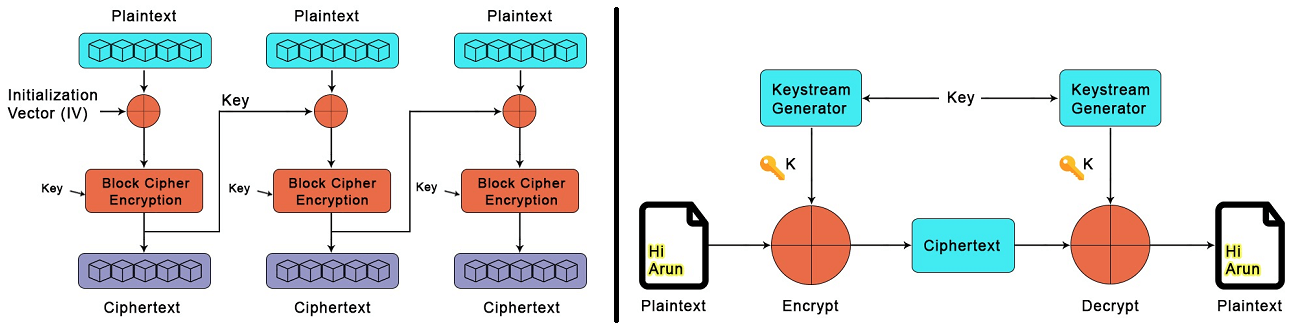
( Image Source : https://www.javatpoint.com/ )
This section introduces some basic concepts that should be known about cryptographic algorithms. In the next section of the module, The Historical Development of Cryptographic Algorithms will be explained.