 Mini-Module

Summary
The Authentication and Authorization module is designed for detection engineers, Cybersecurity professionals, and System administrators. Throughout this module, students will develop an understanding of the fundamental concepts of authentication and authorization in cybersecurity and to implement strong authentication mechanisms to protect against unauthorized access.
Recommended prior knowledge:
- Basic understanding of cybersecurity concepts
- Familiarity with IT systems
What is Authentication and What are Authentication Methods?
Authentication and authorization are two basic concepts that have vital importance in terms of information security. Authentication is the process of proving the authenticity of a user's declared identity. The user usually provides credentials such as username and password, and the system verifies this information. This process allows the user to prove their identity in the system and verify that they are a real user. Authorization is a process that takes place after authentication. In this process, the user is granted or denied access to certain resources (files, databases, network resources, etc.). Authorization is accomplished by specifying the user's access rights, assigning roles, and setting permissions as needed. In this way, users can only access the resources they need and unauthorized access is prevented.
Authentication and authorization play an important role in ensuring the security of information systems. Incorrect authentication or weak authorization methods can allow unauthorized users to log into systems and access sensitive data. This puts information security at risk. Therefore, reliable and strong authentication and authorization mechanisms should be used and regularly updated.
What is Authentication and What are Authentication Methods?
Authentication is the process of proving the authenticity of a user's declared identity. In this process, the user provides credentials (username, password, biometric data, etc.) and the system verifies this information. Authentication is performed when the user is logging into the system or accessing certain resources.
The methods used for authentication can vary. Commonly used authentication methods are:
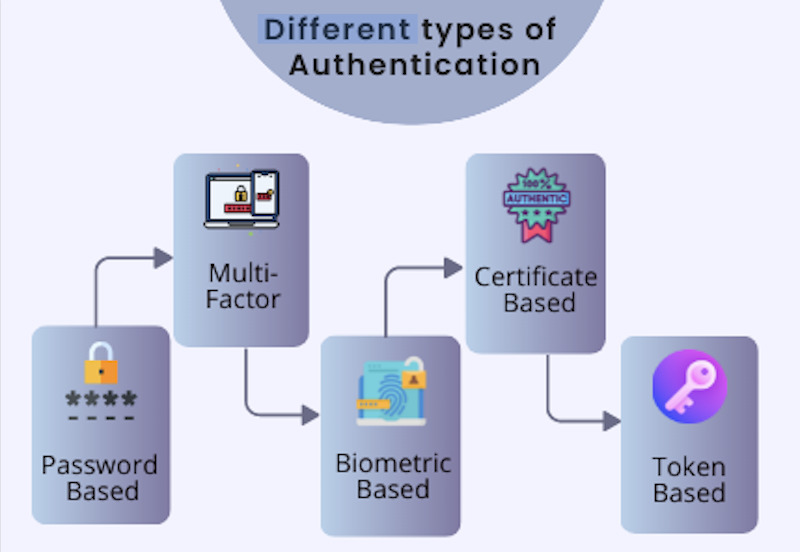
(Image Source:
https://blog.miniorange.com/different-types-of-authentication-methods-for-security/)
Password Based Authentication
The user provides the username-password combination. This information is verified when logging into the system. The password should be strong, changed regularly, and stored securely by users.
Multi-Factor Authentication
It is a method in which more than one validation factor is used. For example, a user name and password may be required, as well as an SMS verification code or a one-time use code generated through an authentication app. This method provides an additional layer of security.
Biometric Authentication
It authenticates using the physical or behavioral characteristics of the user. Biometric data such as fingerprint, face recognition, voice recognition, retina scan can be used. This method provides a more secure authentication.
One-Time Passwords
Users are provided with one-time passwords that are valid for a certain period of time. These passwords are usually transmitted to the user via SMS, email or authentication applications. A new password is required for each session.
Certificate Based Authentication
Users authenticate using a digital certificate. These certificates are usually provided by a trusted third party and contain a key pair that authenticates the user.
These methods are used to authenticate users and provide secure access to systems. The method to be chosen is determined by the user's needs, the application's requirements and security policies.
In this part of the training, we have covered what the authentication and the authorization is, and commonly used authentication methods. In the next part of the training, we will learn about the Authorization and its Methods topic.