Summary
The labs in this module call a live model, so you need your own API key for an OpenAI-compatible provider before you start, as in AI Literacy - Agents. It is preconfigured for OpenRouter but any provider will work.
In AI Literacy - Agents, you built the host-side code that turns model proposals into tool calls. Running those calls under a user's authority also requires decisions about which actions are permitted and how much work the agent may do. Here, you extend that host with permission checks and resource limits, and require human approval for sensitive actions.
When the agent calls another service or delegates a task, those controls have to hold across the whole request. You build an MCP server that checks incoming requests and coordinate workers under shared limits. After a run, the agent's traces and tool results give you a way to examine what happened and decide whether a change preserves the required behavior.
Across the module you will:
- Decide whether a caller may perform an operation by checking permissions and tenant boundaries before execution.
- Apply resource limits and examine what sandboxing and isolation provide. Control which credentials the agent can use and where it can send requests.
- Use intent routing and risk scoring to choose how a request is handled, combining guardrails with human approval for sensitive actions.
- Build authorization checks into an MCP server and coordinate workers under a shared execution budget.
- Record traces of an agent's actions, removing credentials before storage. Use those records to monitor behavior and resource use.
- Evaluate task completion alongside tool effects, and compare automated judgments with those observations. Check changes against earlier runs before reviewing a release.
- Relate the agent's attack surface to security standards, using evidence from the system to assess the proposed defenses.
Hands-on exercises guide you through each technique before you combine them in a practical skills assessment. There, you operate an agent that must complete permitted work while stopping unauthorized actions, then use the evidence it records to support a release decision.
You can start and stop at any time and resume where you left off. There is no time limit or grading, but you must complete all exercises and the skills assessment to receive the maximum cubes and have the module marked as complete in any selected paths.
You need solid Python proficiency and familiarity with Jupyter Notebooks. A firm grasp of these modules is recommended before you start:
From Model to Runtime
When a model generates a tool call, nothing has executed yet. It has proposed an operation and arguments in text. The host application decides whether to run that proposal, makes the call to the tool, and records the outcome.
In AI Literacy - Models, you studied tokens, context budgets, prompt injection risks, and structured generation. A model can emit valid JSON that names an administrative command, but that text has no permission to touch a system on its own.
In AI Literacy - Agents, you connected those proposals to a host loop: the model could request a tool call, receive the result, and continue. The teaching host checked the shape of each call and held destructive or approval-gated tools at needs_approval, but that gate decided from the tool registry alone. It had no caller role or tenant to check, no resource limit for an accepted call, and no way to carry out an action after a person approved it.
Together, the three modules describe one agent system, not three applications running in sequence. The model from AI Literacy - Models supplies proposals. A full agent harness is the host-side code that calls the model, runs the loop and tool interfaces from AI Literacy - Agents, and applies the controls built here; the model is a dependency, not harness code. In this path, runtime owns the execution and evidence responsibilities that the harness and its connected services carry: authorize calls, limit resource use, cross process and service boundaries, and record what happened. It is not a second agent or another name for the entire harness.
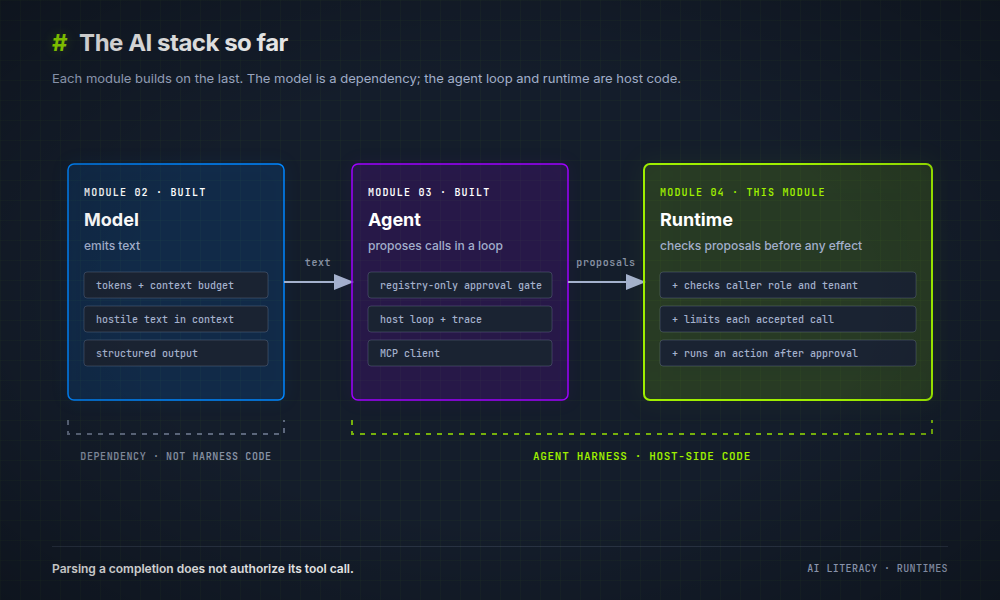
Parsing a model completion does not authorize its tool call. The host must check the proposed action against its own policy, constrain execution, and record the result. The evidence from that run can then support a review of what the controls actually did; a trace alone does not prove the system is safe.
The three groups
The three teaching groups follow the request from decision to execution to review: Control, Protocol, and Proof.
Control governs which proposed actions the host may dispatch and how it handles them. You will check caller permissions, limit a child process's resources, and attach service credentials only to requests for permitted destinations, without putting them in the model's context. Live model proposals also give you cases to route for review, compare guardrail decisions, and require a person's approval before an exact destructive operation. A resource ceiling limits memory or time; it does not by itself confine filesystem or network access.
Protocol follows an authorized request across a process or service boundary. You will build the receiving side of the Model Context Protocol (MCP), rather than only calling a server as you did in AI Literacy - Agents. The MCP server will accept only a bearer token issued for its own resource, and it will call its upstream service with a separate, scoped upstream credential instead of forwarding the caller's token. The host will also charge every worker against one shared execution budget. The host withholds a local peer's entire return when that peer is ineligible or the return looks like instructions; a peer response is data, not authority.
Proof examines what the agent proposed, what the host decided, and what the receiving service did. You will link spans from live runs, redact credentials before persisting traces, score observed behavior against a benchmark, and compare automated semantic judgments with behavioral evidence. Monitoring and regression checks help you investigate changes and defend a scoped release decision. Neither an alert nor a passing score prevents a bad action by itself.
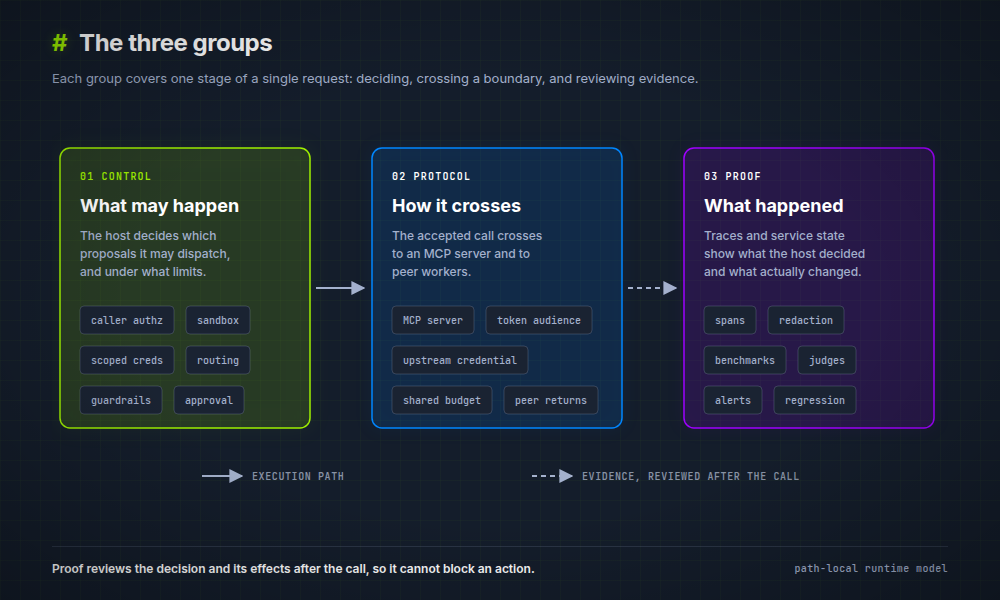
The diagram tracks one request. The solid arrow is the execution path: the host makes a control decision, and the accepted call crosses a protocol boundary. The dashed arrow carries the resulting trace and the receiving service's state to Proof as evidence for review. Proof checks the decision and its effects after the call, so it cannot block an action on that execution path.